



Precise and proper treatment and the path to achieving healthy hair begins with professional diagnosis, after which treatment can be tailored. How is the diagnosis performed and what can be achieved through it? Everything you need to know just before deciding to treat your hair.
One of the well-known principles in the world of medicine and treatment is that in order to achieve the best and most appropriate results in any treatment, the problem must first be accurately diagnosed. In fact, statistical data shows that there is critical importance to the quality of diagnosis. When it comes to hair, a questionnaire or superficial diagnosis alone is not sufficient. In fact, this type of “diagnosis” reduces the success rate of treatment by tens of percentage points and renders it ineffective. So, what is an accurate trichological diagnosis, how should it be performed, and what is its role in the treatment chain? Everything is in the article before you.
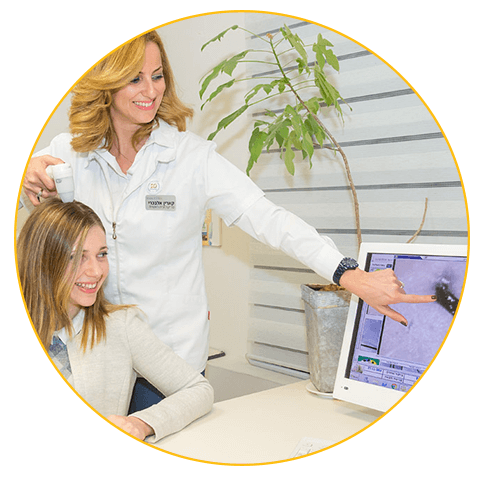
The diagnosis at Hair Clinic is performed by an expert trichologist. A trichologist is a hair science specialist who has undergone in-depth professional training in the field and is qualified to diagnose and treat hair. The diagnosis is conducted over approximately half an hour,
and at its conclusion the client receives a printed trichogram report containing the diagnosis findings and includes several stages:
Medical Questionnaire
The first stage in the diagnosis process includes completing a medical questionnaire. As Israel’s leading body in the field of hair, we need to obtain a complete picture of the client’s medical condition and history in order to understand all the factors affecting their hair condition and how to integrate the treatment with their current state. Ignoring the patient’s medical condition does not provide all the necessary information and thus reduces their success rate. During the questionnaire stage, questions are asked about the patient’s general health status, including: medical condition such as medications or background illnesses that may affect the hair, lifestyle and habits including nutrition, physical activity, stress and mental state, habits and actions performed on the hair such as salon treatments, straightening, coloring and more, and even questions about sleep hours and quality. A proper questionnaire can reveal the complete picture and greatly assist in characterizing the cause of the disorder or disease.
Scalp Examination
After receiving the medical information, we proceed to the scalp examination stage in order to diagnose its current condition and understand how it can be treated. For hair to grow, thrive and regenerate, the scalp must be flexible and not tight, and blood supply to it must be rich and unobstructed. Moreover, the natural secretions of the scalp must be produced and distributed properly.
Hair Root Examination
In the next stage, the hair roots are examined in order to assess their strength and the type of treatment needed to strengthen and rehabilitate them. During the examination, the hair growth mechanism is seen in depth and the causes of the problem are diagnosed. Hair treatment focuses on the hair’s developmental environment—the roots. The goal is to restore normal function to the growth systems and life cycles of the hair, which begins at the root. From decades of experience, we know that improving the living conditions of the roots leads to healthier hair life.
In order to make the diagnosis as accurate as possible and provide a complete picture of the hair condition, our professional team uses microscopic examination. The microscopic examination is non-invasive and painless, and the entire diagnosis is performed by a trichologist (hair specialist) using a unique diagnostic device that magnifies the examination area 50 times and the hair roots 200 times. The information is transmitted digitally to a screen that reflects the scalp condition, hair environment, hair roots and the hair itself. The examination measures hair density and thickness, quality of regeneration, condition of hair roots and scalp.
The microscopic examination is an integral part of the diagnosis process and provides our hair specialists with the complete picture of your hair and scalp. Continuing treatment ensures very high chances of achieving healthy hair with strong, supportive roots.
Be sure to check these five points in order to ensure the success rate of your hair treatment and guarantee yourself reliable, quality, safe and accurate treatment for your condition.