



Women and men experience various forms of hair loss at different stages of their lives.
In some cases, treatment is simple (such as supplementing certain vitamins or minerals through dietary changes or nutritional supplements), and in other cases, treatment is more complex.
Even if you are not aware of it, we all lose hair on a daily basis, with shedding of 50-100 hairs per day considered normal. Beyond that, a hair loss problem may develop that requires attention and even treatment.
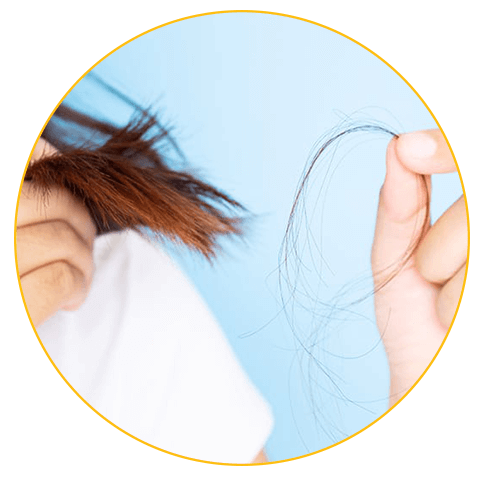
Important to know: Hair renews itself in a 3-stage cycle:
Stage 1 – Growth Phase (Anagen):
This is the stage where the hair begins to grow from within the skin. The duration of this stage varies from person to person depending on genetic and environmental factors and can last between two to six years. Most of the hair on your head is in this stage at any given moment. The length of the growth phase affects the length of the hair.
Stage 2 – Transition Phase (Catagen):
This is the stage where the body signals and stops the growth process. At this stage, the hair follicle that supported the hair throughout the growth process detaches from it. The hair is still attached to the skin, but because blood supply to it has stopped, it begins to be “pushed” outward. This stage lasts approximately ten days to two weeks on average.
Stage 3 – Resting Phase (Telogen):
This is the stage where the hair has completed its life cycle, detaches from the root, and is pushed out by a new hair growing in its place.
A new hair then grows and “pushes” out the old hair.
Hair loss can result from a “malfunction” in any of the above stages and from additional reasons, some of which we will detail later in the article.
While hair loss is more common among men, thinning hair, hair shedding, and hair loss actually affect both sexes. The main problem is: there is not just one reason causing the phenomenon.
Fortunately, there are ways to treat hair loss in both men and women (treatment options depend on the cause, of course).
Here are some common and less common reasons causing you to see less and less hair on your head and what you can do about it.
This is a process called telogen effluvium, or excessive hair shedding caused by stress, according to Karin Albacharry, chief trichologist at Hair Clinic.
Our body interprets psychological stress similarly to physical stress, and any stress in the body causes a halt in scalp hair growth. When hair growth stops, especially due to stress, the body releases the hormone cortisol, which affects hair follicles and thus leads to thinning or hair loss. This phenomenon can occur even months after the stressful event, notes Albacharry.
Of course, preventing stress is the easiest way to prevent this type of hair loss… but, with most of our lifestyles, this is not always simple to accomplish.
If you are experiencing this type of hair loss, sometimes dedicated treatment is needed that works to dilate blood vessels around the hair follicle to revitalize and help the hair grow again. Even if treatment begins, it is important to wait patiently and give the hair time to grow.
The pregnancy period and the postpartum period are examples of physical stress that can cause hair loss due to hormonal changes occurring during pregnancy, and even more so after childbirth, creating a “recipe” with high probability for hair loss. By the way, pregnancy-related hair loss is more common after childbirth rather than during pregnancy.
Naturally, the birthing process is traumatic to the body. If your shedding is a result of pregnancy, in many cases the hair will grow back within several months—this is normal and usually resolves on its own. However, if the hair becomes thinner than before and the hair partings (especially in the upper section) widen, this may indicate an additional problem requiring further diagnosis and examination. A trichological assessment can map out your hair condition and the causes of shedding for you and provide the necessary response if needed.
According to the American Academy of Dermatology, a diet low in protein can lead to hair loss. This is why people following a “keto” diet often report hair loss.
You can easily add protein to your diet by incorporating eggs, tuna, chicken breast, beans, yogurt, and similar foods into your daily nutrition.
If you come from a family where women began losing hair at a certain age, it is very likely that you have a genetic predisposition to hair loss, shares Karin Albacharry.
It is not pleasant, but it is important to know that genetic predisposition is one of the most common causes of hair loss.
Unlike men, women do not have a receding hairline; instead, their part may widen and they may have noticeable thinning of hair—a phenomenon known as “female pattern baldness.”
Similar to any predisposition (predisposition to weight gain, predisposition to high blood pressure, predisposition to diabetes, etc.), a predisposition to hair loss or thinning hair can also be addressed therapeutically and minimized to the extent possible, so that it will not be noticeable and will not interfere with our lifestyle.
Hormonal changes and also switching or discontinuing birth control pills can cause hair loss, and the likelihood increases when there is a family history of hair loss.
Additionally, hormonal imbalance during menopause can cause hair loss. Androgen (male hormone) receptors will decrease, and then hair loss begins.
If the shedding results from discontinuing birth control pills, it is usually a temporary condition that will pass. If the shedding continues for an extended period, or if widening partings or hair thinning develop, a professional trichological assessment is needed to examine the cause or causes of hair loss.
Not getting enough iron from the diet can lead to hair loss and even typical hair loss on the sides of the head (temples) in women.
Iron deficiency anemia (according to the National Heart, Lung, and Blood Institute) occurs when you do not have enough iron in your body.
In addition to increased hair loss, symptoms of iron deficiency may include, among others: fatigue, shortness of breath, or chest pain.
A blood test can indicate a problem with “iron stores” (ferritin) and levels that are insufficient for proper hair function. For example, a normal test result may be in the minimum range of 40 nanograms per milliliter, meaning a doctor will not be “alarmed” by these results, but for proper hair growth function, a minimum amount of at least 70 nanograms per milliliter is required—hence the importance of consulting with a trichologist (and hence the importance of trichological perspective and interpretation regarding hair health, as well as dozens of other tests).
To help treat hair loss resulting from iron deficiency, it is important first of all to medically diagnose the source of the iron deficiency and/or the body’s inability to absorb and process iron. Concurrently, iron supplements are required along with lifestyle changes and dietary adjustments to one rich in iron and vitamin C.
Thyroid problems—overactivity (hyper) or underactivity (hypo) of the gland—can cause a variety of hair problems according to dermatological research.
Among the problems: sparse or missing eyebrows (especially at the outer edge of the eyebrow), soft and fine hair with much shedding, thinning hair, and less hair on other body parts.
To treat this problem, medication is required to balance the gland. Concurrently, and after a trichological assessment through which you confirm that the source of shedding indeed stems from the thyroid gland, treatment can be tailored to help reduce shedding and rehabilitate damage and improve hair health.
Alopecia areata is an autoimmune phenomenon (the body’s immune system attacks the body itself).
Immune system cells (lymphocytes and other cell types) attack hair follicles and cause hair loss.
Alopecia areata is a common skin condition causing hair loss on the scalp and elsewhere (eyelashes, eyebrows, beard, etc.) and is characterized by circular or elliptical bald patches, appearing in approximately 2% of the population.
The condition affects all age groups, genders, and ethnic groups.
There are different types of alopecia, but all cause some form of hair loss characterized by localized baldness, and there is no way to predict if or when it will appear.
There is no cure for alopecia, but the localized baldness phenomenon can be treated through treatments that accelerate the recovery rate of hair growth.
Lupus is an autoimmune disease in which the immune system attacks the body’s healthy cells and tissues such as joints, skin, kidneys, heart, lungs, blood vessels, and brain—due to “mistaken identification” by the body.
Hair loss is a common side effect of lupus and of the medications used to treat lupus.
Sometimes there is scarring in areas of hair loss, which may inhibit regrowth of hair in those areas.
If the shedding is a result of the medications, in most cases the hair will slowly grow back after discontinuing use of the medications (discontinuation of drug treatment under the guidance of the treating physician only).
Rapid weight loss causes a type of physical trauma to the body that can lead to thinning hair; this happens even if the weight loss is good for you.
It may be that the weight loss stressed the body or that the stress stems from vitamin and mineral deficiency, and as a result the hair begins to shed or thin.
Additionally, hair can also shed as a result of bulimia or anorexia.
Unfortunately, some of the medications that help us fight the cursed cancer disease can cause hair loss.
Chemotherapy is like a nuclear bomb for the body. It destroys rapidly multiplying cells, meaning cancer cells, but also rapidly multiplying cells such as hair.
After stopping chemotherapy, the hair will grow back; however, it will usually grow with a different texture than it had before treatment.
Recent research is working on other medications that will “bypass” the side effects, and we hope they will find such solutions soon.
Polycystic ovary syndrome is an imbalance in male and female sex hormones (PCOS).
Excess androgens can lead to ovarian cysts, weight gain, relatively high risk of diabetes, changes in the menstrual cycle, infertility, and also: hair thinning and loss.
Because male hormones are overrepresented in PCOS, women may experience increased hair growth on the face and body.
In certain cases, treatment of hormonal imbalance is performed through diet, physical activity, and birth control pills, and sometimes with specific treatment for infertility and diabetes risk.
Concurrently with treating the imbalance, hair loss can be treated after the phenomenon has been diagnosed through trichological assessment as a cause of hair loss.
Certain types of medications may cause hair loss.
The most common and well-known are medications including blood thinners and blood pressure medications (known as beta blockers), non-steroidal anti-inflammatory drugs, medications for skin diseases, and more.
The response is divided into 2:
A. It is recommended to perform a trichological assessment to examine what is causing the hair loss. After the professional diagnosis, treatment can be tailored to provide the specific, precise response to treat hair loss in the most effective way (treating the problem at its root).
B. Concurrently, it is recommended to consult with your treating physician regarding the possibility that your medications are causing hair loss. They may suggest switching to another medication or lowering the dosage.
Keep in mind that using chemical and/or mechanical substances and tools (equipment) may cause hair breakage, and we recommend minimizing their use as much as possible and/or preferring more natural substances and methods. True, in many cases they cost slightly more and do not achieve “amazing” results easily, but they are healthier for your hair in the long term.
Tight braids, hair weaving, coloring, hair straightening, oil or harsh chemical treatments with or without high heat (and additional methods) can affect the hair root, damage it, and in more extreme cases cause a situation where the hair will not grow back.
In other words, the disulfide bonds found in the hair fiber break, and the hair breaks, and the overall hair volume decreases.
It is important to ensure selection of skilled professionals and use of substances considered “safer.”
Trichotillomania is classified as an “impulse control disorder” that causes people to pull out hair compulsively. Similar to “tics,” the person constantly plays with and pulls hair unconsciously and beyond their control.
This repetitive behavior may cause damage to the hair root and its weakening, and as a result cause shedding.
This phenomenon is 4 times more common in women than men.
Here too, the response is divided into 2:
A. It is recommended to perform a trichological assessment to examine what is causing the hair loss. After the professional diagnosis, treatment can be tailored to provide the specific, precise response to treat hair loss in the most effective way, strengthen the hair root, and encourage renewed growth.
B. Studies indicate favorably the use of various behavioral modification therapies, and in more extreme cases, professional authorities may prescribe various types of antidepressant medications, all with the goal of treating the phenomenon and minimizing it as much as possible.
It is not rare to see women aged 50-60 with hair loss or thinning hair. In most cases, the phenomenon cannot be explained.
Along with the hair loss phenomenon itself, as a result of discomfort or mental or emotional difficulties, situations arise where people avoid social gatherings, and thus, in effect, their lifestyle and quality of life are impaired.
Women aged 50 plus are active women, full of life, and there is no reason to avoid any activity because of hair loss, especially in light of the fact that available and effective solutions exist that will help you cope with the phenomenon easily.
What Can You Do?
The cosmetic approach: There are several cosmetic approaches, and scarves, hair extensions, and hair styling can be used to cover bald or thinning areas. At Hair Clinic health clinics, professional solutions are provided precisely for this phenomenon, and the results are impressive. This is much more than a salon—it is a specialist “salon” that treats precisely these phenomena.
The therapeutic approach: It is recommended to conduct a trichological assessment to examine what is causing the hair loss. After the professional diagnosis, treatment can be tailored to provide the specific, precise response to treat hair loss in the most effective way.
There are treatments to prevent hair breakage and ways to keep hair looking shiny and healthy even at ages 50 and above.
Studies indicate that excessive consumption of supplements or medications containing vitamin A can trigger hair loss.
The daily intake of vitamin A is 5,000 IU per day for adults and children over age 4. Supplements can contain between 2,500 to 10,000 IU (!), and hence the excess that may affect the phenomenon or worsen it.
The good news: This is a reversible process, and once the excess vitamin disappears, hair growth will return to its previous state.