



Stress, depression, anxiety—these are just some of the reasons. Not everyone can cope with the pressure of standing before an audience, and there are those who experience difficulty functioning in a social environment or dealing with the stress before an exam. These individuals struggle to control their emotions and they must do something; unfortunately, this manifests itself in hair pulling.
The problem develops over time—the more hair is pulled, the more exposed areas appear on the scalp that are visible to the eye, sometimes to the point of actual baldness. This creates an increase in feelings of disgust, alienation, and helplessness, and leads to heightened feelings of withdrawal and depression, and so on.
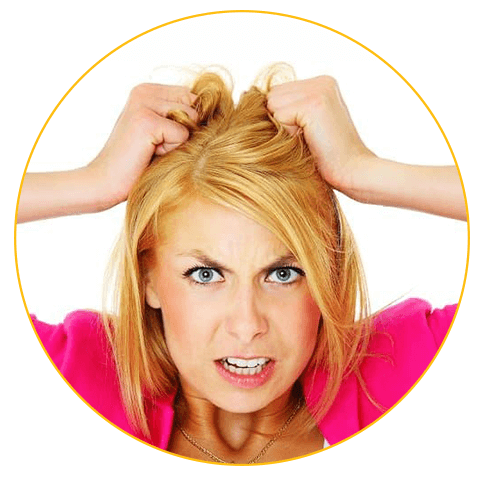
Trichotillomania is primarily driven by a psychological state and is perceived as a behavioral disorder. Therefore, the ideal treatment for this phenomenon is cognitive behavioral therapy focused on changing habits, in which the patient learns to control their impulses and learns to understand what motivates them to perform the action.
The trichologist is qualified to diagnose the phenomenon through microscopic examination and can provide a practical solution for hair that has been damaged and weakened as a result of repeated pulling. The proposed solution is treatment with dedicated products to strengthen the roots of the damaged hair, improve growth, and encourage its recovery. Additionally, if necessary, an aesthetic supplement can be incorporated to cover the affected area. The trichologist must also recognize and be aware of the connection between emotional state and its effect on hair health.
As a certified trichologist, it is not enough to examine the hair under a microscope; one must look at the person as a whole and question them through conversation about various parameters in their life, all in order to provide an accurate diagnosis of the problem and offer a personalized solution for each patient.
It is important to note that there is difficulty in diagnosing the problem, and only through microscopic diagnosis by a certified trichologist can it be identified that it is indeed hair pulling, preventing incorrect diagnoses and, worse yet, medical treatment that does not match the cause of the problem.