Trichology is a field that deals with the science of hair and scalp. The origin of the word “Trichology” comes from the Greek word “Tricho,” which means hair.
The field focuses on the study of hair, scalp, and the various factors that may affect their health. Trichologists work to identify possible causes of hair loss, hair thinning, scalp problems, and changes in hair structure and quality.
It is important to understand that hair loss is not a single disease with one cause. Two people may experience similar symptoms but for completely different reasons. In one person, it may be a hormonal change; in another, a nutritional deficiency; in a third, a scalp problem; and in a fourth, a genetic factor.
This is why one of the central principles in trichology is to understand not only what is visible on the surface but also what may be causing it.
A trichologist is an expert in the science of hair and scalp.
The goal is to assess the condition of the hair and scalp, identify possible factors affecting them, and help build a personalized action plan tailored to each individual’s condition.
During the trichological diagnosis, various factors are sometimes examined, such as:
Since hair is affected by many factors, the examination does not focus only on the hair itself but on the broader picture.
A trichological diagnosis is designed to create a comprehensive picture of the condition of the hair and scalp and to understand which factors may be affecting them.
During the diagnosis, the following may be examined:
At the end of the assessment, possible factors contributing to the hair condition can be discussed, and recommendations regarding the next steps can be provided based on the findings.
At Hair Clinic, the diagnostic findings serve as the basis for tailoring a personalized plan within the framework of the Hair Clinic method.
Not all hair loss requires treatment, but there are situations in which professional evaluation is recommended.
You should consult a certified trichologist when one or more of the following conditions appear:
The sooner you understand what may be affecting the hair and scalp, the easier it is to choose the appropriate course of action.
One of the main reasons people struggle to deal with hair loss is the fact that hair loss can result from a wide range of factors.
Among the common causes are:
For example, a condition called telogen effluvium (Telogen Effluvium) may cause increased hair loss several months after a period of significant stress, illness, or childbirth.
In contrast, androgenetic alopecia (Androgenetic Alopecia), also known in women as female pattern hair loss (Female Pattern Hair Loss), typically develops gradually over time.
Although the final result may appear similar—hair loss or thinning—the approach to dealing with each condition may be completely different.
Modern trichology began in the early 20th century in England. Over the years, the field has developed and become a professional discipline that combines knowledge from the fields of biology, hair and scalp health, and ongoing research on hair loss.
In 1974, the International Association of Trichologists (IAT) was founded by David Salinger, an organization that works to advance research, training, and professional knowledge in the field of hair and scalp.
Today, trichologists operate in many countries around the world, and the field continues to develop as new knowledge about hair health accumulates.
Hair Clinic is an active member of the International Association of Trichologists (IAT) and participates in professional activities, seminars, and conferences in the field of hair and scalp.
In 2010, Karin Elbacharry, a certified trichologist with international certification in the field, joined the international organization. Today, Karin Elbacharry serves as the chairperson of the IAT board of directors and is responsible for trichologist training in Israel on behalf of the organization.
Today, the company continues to follow professional developments in the field of trichology and to integrate up-to-date professional knowledge into the diagnostic and treatment processes.
Is a trichologist a doctor?
Not necessarily. A trichologist does not have to be a doctor. A trichologist is a certified expert in the science of hair and scalp who has undergone professional training in the field of hair and scalp science. After the trichological diagnosis, the trichologist will decide, if necessary, whether to refer for medical evaluation.
Does a trichologist only treat hair loss?
No, the field of trichology is much broader than hair loss alone. Trichologists deal with a variety of conditions related to hair and scalp, including hair thinning, dandruff and seborrhea, excessive oiliness or dryness of the scalp, itching and redness, changes in hair texture and quality, localized bald patches, and hair diseases. In each of these conditions, the goal is to understand what is causing the problem—not just to focus on the symptom itself.
Is a blood test required before a trichological diagnosis?
No. Based on the findings of the trichological diagnosis, the trichologist will refer for targeted blood tests according to the examination findings and if necessary.
What is the difference between a trichologist and a dermatologist?
The main difference is in training and focus. A dermatologist is a medical doctor specializing in the diagnosis and treatment of skin, hair, and nail diseases. A trichologist focuses specifically on the science of hair and scalp and examines factors such as nutrition, lifestyle, personal history, and habits that may affect them. Sometimes the two professionals work in parallel. A trichologist is the highest authority on hair and scalp problems. Only a dermatologist who has specialized in trichology can diagnose hair and scalp problems.
Is it advisable to see a trichologist at the onset of hair loss?
Yes, early consultation may be beneficial. The sooner you understand what is causing the change in hair condition, the easier it is to understand what is behind the hair loss and to choose the appropriate course of action.
How long does a trichological diagnosis take?
A trichological diagnosis typically takes about 30 to 45 minutes. During the diagnosis, personal and medical history is reviewed, the condition of the hair and scalp is assessed, and possible factors affecting the condition are discussed. This time is necessary to get a complete picture—not just to look at the visible symptom. Diagnostic results and treatment recommendations are provided on-site.
Is a trichological diagnosis painful?
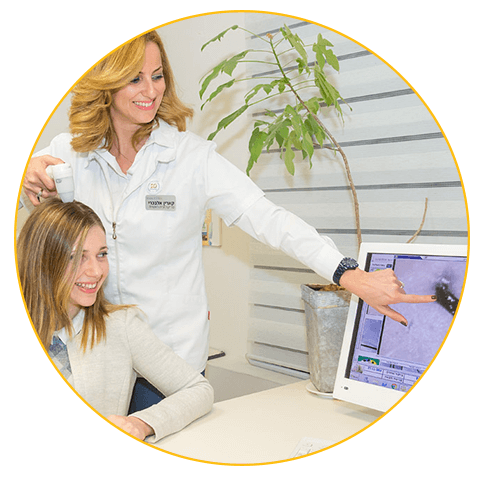
No. A trichological diagnosis is a non-invasive and painless process. It typically includes a visual examination of the hair and scalp using a computerized camera microscope, along with a detailed discussion of personal and medical history.
How should I prepare for a trichological diagnosis?
No special preparation is required. It is recommended to come to the appointment with information about regular medications, dietary supplements, background medical conditions, and recent blood tests if available.
This content has been reviewed and approved by Karine Albakri,
Chief Trichologist at Hair Clinic