



Our children, and even we at a young age, have always admired and envied those children with full, well-groomed, beautiful hair.
However, luck does not meet everyone in this regard. Nutritional issues, fungi, genetics, stress, hygiene, unsuitable products, and hairstyles can cause hair loss in children at a young age.
However, you will be pleased to know that in many cases, with early identification and appropriate treatment, it is possible to treat this hair loss.
This happened to Roni about 3 weeks ago. She arrived at the clinic with her father, both looking worried. Roni’s father shared that he noticed severe hair loss in Roni’s hair. And even after they tried buying her new hair care products, the phenomenon continues to occur. Roni’s father explained that this causes Roni to feel insecure when she is around her friends and classmates, and she often gives up social gatherings because of it.
Roni’s difficult story is not an isolated case. It can happen to boys and girls of all ages. However, before jumping to severe and hasty conclusions, often, vitamin supplementation and improved eating habits, for example, can be the appropriate solution.
For instance, in Roni’s case (and many others), the hair loss stems from iron deficiency in the body. With the help of an appropriate hair test and blood test, it was possible to identify the problem and solve it.
Another example is the story of Omri, who suffered from baldness at the age of 7. His shy smile and beautiful eyes were hidden under a hat that accompanies him throughout the day, his mother told us. In this case, it was not a vitamin deficiency, but rather a very stressful period that Omri was experiencing. Moving to a new school and additional family matters led Omri to experience hair loss.
The solution? Help the child experience calm, and gradually, the hair condition will improve as well.
Did you know? Hair loss in children is a very common phenomenon. According to estimates, nearly 10% of the inquiries received by a pediatric dermatologist in the United States are about “problematic hair.”
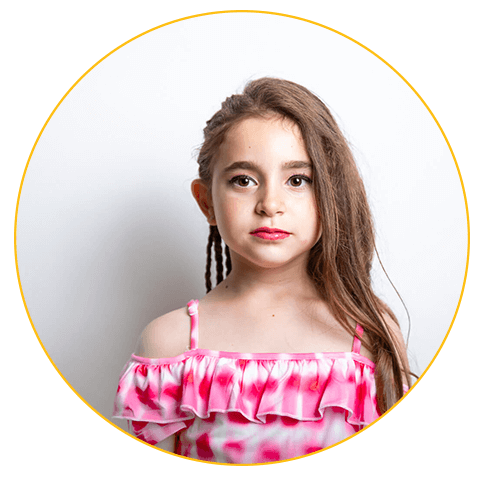
There are several reasons why children may suffer from hair loss in various areas. In the following paragraphs, you will find the most common phenomena:
Hair loss as a result of tinea capitis. Tinea capitis is a common phenomenon in which an infectious fungus causes damage to the hair. Signs of tinea capitis include baldness in the scalp area and, in various cases, damage to eyebrow hair and eyelash hair.
Tinea capitis causes damage in several ways:
Damage to the hair shaft
Hair breakage
Damage to hair follicles
Appearance of black dots on the skin
Itching and scaling
How can tinea capitis be treated? Treatment for tinea capitis is usually performed using an appropriate medicated shampoo. In more severe cases, medications are also used.
Hair Loss as a Result of Alopecia Areata
Alopecia areata is a phenomenon that usually appears suddenly without warning signs.
Quite rapidly, the hair begins to break, become weaker, appear seemingly longer, and take on a rounded shape.
Alongside these signs, alopecia areata is also characterized by bald patches in the scalp area and even pitting in the nails.
In this phenomenon, the child’s body develops antibodies against the hair’s pigment proteins. In other words, the body “attacks” itself (autoimmune).
One of the triggers identified for this problem is stress and anxiety.
How can alopecia areata be diagnosed? Through microscopic examination of a hair follicle.
How can alopecia areata be treated? Through cortisone injection into the affected area and use of ointments designed to irritate the skin. In this way, hair growth can be restored.
It is important to know that the hair usually grows back in white and only later regains its original color. In many cases, even without treatment, the hair grows back.
Hair Loss as a Result of Hair Pulling – Traction Alopecia
In this case, the phenomenon occurs due to pulling the hair backward with force. Over time, this pulling leads to hair damage, and the result? The front hairline recedes.
The phenomenon is especially common among girls who frequently pull their hair back, whether using buns, elastics, or even straightening irons, smoothing treatments, or curling.
How can traction alopecia be diagnosed? Through regular observation.
How can traction alopecia be treated? Stop pulling the hair and avoid using chemical treatments.
Hair Loss as a Result of Trichotillomania
Trichotillomania is a hair problem that occurs as a result of self-pulling of the hair. Children may pull their hair as a result of severe stress and distress. Children who experience abuse and harm may pull their hair.
In this case, the hair roots will appear broken and damaged.
How can trichotillomania be treated? Mental health services should be utilized. A psychologist and, in certain cases, a psychiatrist.
There are additional common phenomena that lead to hair loss, including telogen effluvium and loose anagen hair syndrome.
For professional assistance from an expert team, you are welcome to contact us, and we will be happy to help you and your child diagnose the problem and treat the hair loss.