



A woman in many cases spends many hours at the salon and performs various chemical treatments on her hair such as straightening, coloring, or perming.
A woman undergoes many hormonal changes during different life stages, such as changes during puberty, use of birth control pills, hormonal changes during pregnancy and childbirth, changes during menopause, and other changes – all of which greatly affect hair texture and thinning.
In addition to this, there are other factors that have an impact, such as climate changes, weight changes through unbalanced diets, various medications, illnesses that affect the hair, all kinds of environmental factors, and especially a great deal of daily stress – and we have the winning recipe for a serious hair problem.
Many women invest a lot of money and time in hair care, and they are more bothered than men by hair that doesn’t look good. Therefore, the phenomenon of hair loss in women is a particularly troubling phenomenon that needs to be treated with personalized care and to establish habits that can prevent hair loss before it even begins.
Hair is the frame of the face, and it has a great influence on a woman’s appearance and how she feels. Therefore, when there is a change in it, she feels it immediately and will try to find a solution. When looking for a solution to hair problems, you must first find the cause of the problem, and this is done through professional diagnosis.
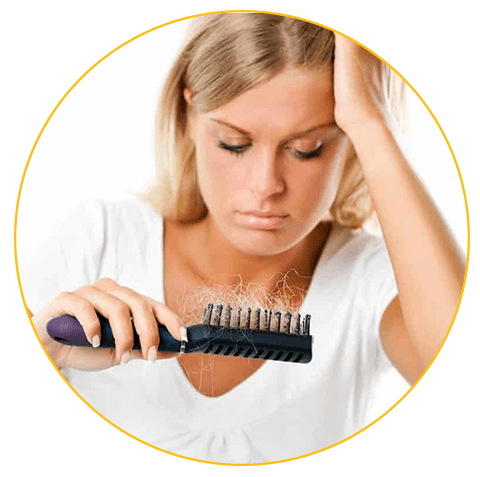
Because hair loss is only the symptom.
Is there hair loss due to various physiological and hormonal changes that a woman goes through during her life?
Is there hair loss because of excessive use of hair straighteners that cause hair breakage or a blow dryer?
It is clear to us that the treatment in both cases is completely different. One problem is a scientific and physical issue, while the other is cosmetic and aesthetic. The scientifically accepted method worldwide for diagnosing hair problems is performing a microscopic examination of the scalp and hair, and through the examination, it is possible to find the causes of the problem and treat them.
Before deciding on treatment, it is important to know that treatment for hair loss in women focuses on the environment where hair develops – the scalp and hair roots.
There is no substitute for direct treatment at the site where the problem exists. Hair roots are the foundation for the vitality and abundance of hair – in this area, cells multiply and develop, they are full of life and energy and enable hair growth. In contrast, the hair we see with the naked eye is already “dead” hair and is composed of non-living cells. Therefore, only what is done to strengthen the hair roots is what will ultimately allow us to have strong, healthy, and full hair.
And as an analogy from the plant world – for a plant to be strong and grow, you need to take good care of the soil by constantly watering and fertilizing it, and thus the roots will receive energy – if this is done consistently, we will have a strong and beautiful plant.
What else can be done?
For hair loss in women, there are no quick magic solutions. You need to act on several levels when dealing with a hair problem. It is advisable to focus on various actions such as:
• Reducing as much as possible and protecting our hair from unnecessary things such as salon treatments that involve chemical substances, and using medicinal products with harmful side effects.
• Maintain a healthy lifestyle that includes reducing alcohol and smoking, proper nutrition, and regular physical activity
• It is advisable to reduce stress levels of the body and mind because stress is problematic. It is recommended to focus on love, relaxation, and rest – this is not something obvious given the way we live today!
Hair loss in women is exactly that – when a woman experiences unexpected heavy loss of hair. Generally, people shed 50 to 100 individual hairs per day. Hair loss is part of a natural balance – some hairs fall out while others grow. When the balance is disrupted – when hair falls out and less hair grows – hair loss occurs. So the more accurate name is hair loss. The medical name for hair loss is alopecia.
Hair goes through three stages:
The anagen phase (growth phase) can last between two and eight years. This phase typically refers to about 85% to 90% of the hair on your head.
The catagen phase (transition phase) is the time when hair follicles shrink and lasts about two to three weeks.
The telogen phase (resting phase) lasts between two and four months. At the end of this phase, the hair falls out.
The vast majority of the time, hair on the scalp is in the growth phase. Only about 10% of follicles are in transition or rest at any given time. Hair grows about six centimeters per year for most people.
The best way to think about hair growth is to imagine a garden. How well the plants grow is entirely a result of what happens “underground.”
Like a garden, a normal hair cycle should lead to the final product, which is hair. Hair growth cycles are important because when something goes wrong with them, it can cause hair loss.
There are several things that can interfere with the cycle – such as infections, illnesses, medications, or chemicals – which have the potential to prevent proper hair formation.
The hair cycle is very dynamic, and anything that can interrupt the cycle can cause hair loss.
Although hair loss and thinning hair or baldness may seem like a problem that is more prominent in men, women also have a high likelihood of losing hair or reaching a state of thinning hair. Typically, women notice this in their 50s or 60s, but it can happen at any age and for various and diverse reasons.
If the hair follicles are uniform in size, or if the hair loss is sudden, it is likely caused by something other than heredity, such as a changed medical condition.
There is a wide range of medical conditions that can cause hair loss, with some of the most common being pregnancy, thyroid disorders, and anemia. Others include autoimmune diseases, polycystic ovary syndrome (PCOS), and various skin conditions such as psoriasis and seborrheic dermatitis.
Although there is a connection between menopause and hair loss, it is not clear whether there is actually a direct link. It may be that menopause and hair loss simply occur at the same age.
Other causes that can lead to hair loss include physical trauma such as surgery or serious illness, a mental state of extreme stress, significant weight loss over a short period of time, taking an overdose of vitamin A, and many others. Hair loss can occur anywhere from a few weeks to six months after any of these experiences.
Someone can undergo surgery and be completely fine, and then two weeks later their hair starts falling out, and it can be very frightening when it starts falling out in large clumps.
One additional way hair becomes thin is caused by the woman’s direct action – hairstyles such as overly tight braids can cause hair loss called traction alopecia.
All the things women do to maintain their hair – dyes, chemical treatments, poor brushes, hair dryers, or straighteners – can cause damage and breakage. This includes excessive brushing and aggressive towel drying when the hair is wet.
Fortunately, in most of these cases, the hair grows back or the hair loss is reversible with medical treatments. But it is important to see a trichologist if something seems wrong, because the earlier you start treatment, the better the chance of improving your hair growth.